

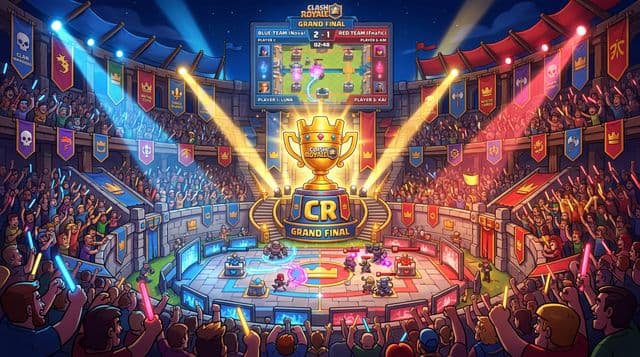
Quick answer: Global Tournaments run twice a month in Clash Royale, cost nothing to enter, and standardize your owned cards to a level cap the event sets — anywhere from 11 to 14 — unless the tournament runs a Special Event Challenge rule with a fixed deck instead. You accumulate wins toward one-time rewards and drop out after a set number of losses, exactly like a Challenge, with a Gem-purchasable bonus track beside the free rewards and extra bonuses for a high finish on the global leaderboard.
There is a particular kind of excitement that only competitive Clash Royale can produce -- that moment when you queue into a match knowing that thousands of other players are fighting simultaneously for the same leaderboard spots, and that every single win matters. Global Tournaments brought that feeling to the game years ago, and their removal left a hole in the competitive ecosystem that Challenges and Ladder could never quite fill. With the 10th anniversary update in March 2026, Supercell has officially brought them back. What follows is how the mode actually works today: the free and Gem reward tracks, the loss budget that ends your run, the level cap that can sit anywhere from 11 to 14, and the global leaderboard that pays bonuses on top of everything your win count already earned.
If you played the original Global Tournaments, more of what you remember still applies than you might expect — the same win ladder, the same Gem bonus track, the same drop-out-on-losses structure. If you have never played one, you are about to discover what many veteran players consider the purest competitive format Clash Royale has ever offered. This guide breaks down every mechanic, every reward, and every strategy you need to climb the leaderboard.
How Global Tournaments Work in 2026
Accessing Tournaments
The first thing returning players will notice is how much easier it is to find and enter Global Tournaments. They now appear directly in the Game Mode Switcher -- the same rotation menu where you find Party Mode, Path of Legends, and other game modes. There is no separate tab to navigate to, no buried menu, and no confusion about when one is active. When a Global Tournament is live, it sits right alongside your other options.
Entry was gated behind King Level 19 for years. The 2026 Q2 Update on May 26, 2026 removed Experience and King Level from Clash Royale entirely and moved feature unlocks onto Trophy Road: Clans and Deck Slots at Arena 1, Clan Donations and Pass Royale at Arena 2, Clan Wars and Clan Trading at Arena 3, Card Mastery at Arena 4, Star Points at Arena 5. Global Tournaments appear nowhere on that list, and Arena 3 is where Clan Wars and Clan Trading open up rather than tournaments. The Game Mode Switcher shows a live tournament the moment your account can enter one.
Match Format and Card Levels
Every Global Tournament that uses your own deck standardizes your owned cards to a level cap the event sets — anywhere from 11 to 14. Level 11, tournament standard, is the floor of that range and the common case. Some Global Tournaments instead run a Special Event Challenge rule, where you do not bring your own deck at all and every card and Crown Tower is fixed at Level 11. Check which rule the event is running before you build. This is a critical detail that shapes the entire competitive landscape of the mode. You cannot use cards you have not unlocked, which means your collection still matters. However, every card you do own is standardized to the same level, which removes the pay-to-win element that plagues Ladder. A free-to-play player with a diverse collection competes on perfectly equal footing with a maxed player. The only difference is which cards are available in each player's deck builder.
Level 11 is the classic tournament standard because it sits at a balance point where card interactions remain faithful to the developers' intended design. Troops survive the same number of spell hits, buildings last the expected number of waves, and damage breakpoints align with what you see in balance discussions. If you have been practicing interactions at tournament standard in friendly battles, that knowledge transfers directly — but read the event's level cap first, because a cap of 12, 13 or 14 moves every spell breakpoint you have memorized.
Matches follow standard 1v1 rules with the same overtime and tiebreaker structure as Ladder. There are no special modifiers, no draft mechanics, and no card bans. You bring your eight cards, your opponent brings theirs, and skill determines the outcome.
Duration and Entry
Global Tournaments occur twice a month and each one runs for a set period, typically several days. There is no entry fee — but there is a loss budget. The rules work like a Special Event Challenge: you accumulate wins toward one-time rewards and you drop out of the event once you hit a set number of losses. That single rule shapes every decision below, because it means each match counts in both directions. A bad stretch does not merely cost you leaderboard position; it spends the losses that keep your run alive.
Want this kind of analysis for your own deck?
TrophyCoach reads your battle log and writes a personalized action plan against the current meta — free to start.
What Changed From the Old Tournament System
Players who remember the original Global Tournaments will recognize more of the 2026 version than the community chatter suggests, and the reward structure is the clearest example. Gem-purchasable bonus rewards are still in the game. Depending on how many wins you accumulate, you claim a free reward track — and you can then buy the parallel bonus tier for those same wins with Gems. This is the pay-to-progress dynamic the community has criticized for years: two players at an identical win count walk away with different totals if one of them spends.
What performance alone determines is the free track. How far up the win ladder you climb decides which free rewards unlock, and no quantity of Gems moves you a single rung up that ladder. Gems only unlock the bonus tier attached to wins you already earned. Skill sets your ceiling; Gems decide how much of it you collect. Budget for that before a serious run rather than discovering it at the results screen.
The removal of King Level gating is equally important from a community perspective. With Experience gone from the game as of May 26, 2026, the old Level 19 wall no longer stands between a newer player and a Global Tournament, which increases the participant pool. Larger pools mean more meaningful leaderboard competition, more diverse matchmaking, and a healthier overall ecosystem. It also gives newer players a taste of competitive play early, which historically has been one of the strongest retention drivers in Clash Royale.
The Game Mode Switcher integration might seem like a minor UI change, but it has a real impact on participation. In the old system, many casual players simply did not know when a tournament was active because the feature was tucked away in a less-visited part of the interface. Putting tournaments front and center in the mode rotation means more players see them, try them, and get hooked on the competitive format.
Rewards and the Badge System
Performance-Based Rewards
Tournament rewards scale with your final standing. The exact reward tiers vary by tournament, but the structure follows a consistent pattern: the higher you place on the leaderboard, the better your prizes. Rewards typically include gold, cards, chests, and tokens -- the standard progression currency that fuels your collection growth. The reward screen shows both tracks before you queue — the free rewards you unlock by win count and the Gem-purchasable bonus tier beside them — so you can decide up front whether you intend to buy the second track.
The practical value of tournament rewards should not be underestimated. A strong performance in a single Global Tournament can yield progression equivalent to several days of Ladder grinding, particularly for players in the mid-trophy ranges who face slower daily chest cycles. For free-to-play players especially, tournaments represent one of the most efficient ways to accelerate collection growth without spending money.
What Does a High Leaderboard Finish Pay?
A high leaderboard finish pays extra bonuses on top of the rewards your win count already unlocked. Supercell publishes that mechanic; the cutoffs themselves vary by event and appear on the in-game leaderboard screen while a tournament is live. The Top-1,000 and Top-10,000 numbers that circulate for tournaments actually belong to Ranked, where the top 10,000 carry an exact rank on their Player Profile and the top 1,000 appear in the Hall of Fame.
Practically, the leaderboard is a second reward axis running parallel to the win ladder. Your win count unlocks the free and Gem tracks regardless of where you place globally; your leaderboard position adds to that if you finish high enough. Both are driven by the same input — winning more games before your loss budget runs out — so there is no strategic tension between chasing one and the other. You do not have to choose a lane.
The in-game leaderboard screen is where to check during a run. It shows live standings alongside the bonus tiers attached to them for that specific tournament, which is what any fixed rank number written down in advance cannot do.
Leaderboard and Ranking System
Global Tournaments rank every participant on a single global leaderboard for the duration of the event, and a sufficiently high finish pays extra bonuses. The in-game leaderboard screen is the authoritative view of where you stand while a tournament is running.
The display model varies by event: how ranks are shown, and where any bonus tier begins, are set per tournament and read off that screen. Community posts often import Ranked's Top-1,000 and Top-10,000 cutoffs into tournament advice, but those belong to a different mode with a different leaderboard.
That distinction has practical teeth. Chasing a Top-1,000 cutoff borrowed from Ranked is how players burn a loss budget on a threshold their tournament never had. Read the tiers off the event screen instead.
For most players the leaderboard is a secondary concern anyway. The win ladder pays out regardless of global position, and the losses you avoid on the way up it are worth more than a handful of leaderboard places. Treat a high finish as upside on a run that was already worth making.
Best Strategies for Tournament Success
How Do You Build a Deck for the Tournament Level Cap?
Level standardization changes the meta in ways that are not always obvious, and the direction depends on where the cap lands between 11 and 14. Certain cards that dominate on maxed Ladder get weaker as the cap drops, because their effectiveness rests on level-dependent interactions: a card that survives a key spell at Level 14 might not survive it at Level 11, which flips the matchup outright. Conversely, cards whose value comes from mechanics rather than raw stats -- cycle cards, spell bait cards, cards with unique abilities -- tend to perform at or near their Ladder effectiveness regardless of level.
The strongest tournament decks share a few common traits, and they hold at every cap in the 11-to-14 range. They are built around win conditions with mechanic-driven value rather than stat-dependent value. Miner, Hog Rider, Goblin Barrel, and X-Bow all function at Level 11 almost exactly as they function at Level 14 because their power comes from what they do, not how hard they hit. Heavy beatdown decks built around Golem or Lava Hound can still work, but they are more sensitive to the level-dependent interaction shifts.
You should also build with versatility in mind. On Ladder, you can one-trick a single deck for hundreds of games because you know your card levels give you edges in specific interactions. In tournaments, everyone is on the same footing, which means you will face the full diversity of the meta. A deck that hard-counters three archetypes but auto-loses to two others is a risky tournament choice. Decks with flexible defensive options and multiple offensive angles tend to perform more consistently across the dozens of matches a serious tournament run requires.
Adaptation Over the Tournament
Because Global Tournaments run over multiple days, the meta within a single tournament evolves in real time. The decks that dominate on day one are not necessarily the decks that dominate on day three. Pay attention to what you are facing. If you lose three consecutive matches to the same archetype, consider whether a tech card swap could shore up that matchup without destroying your other matchups — and note that those three losses came out of a budget you cannot refill. The players who finish highest are almost never the ones who locked in a single deck on day one and never adjusted.
Track your matchups mentally or in a note. After 20-30 games, you will have a reliable sample of what the tournament meta looks like, and you can make informed adjustments. Swapping one card -- replacing a second spell with a building, or switching your small spell from Zap to Barbarian Barrel -- can flip a 40-60 matchup into a 55-45 matchup against the most common decks you are facing.
Tips for Climbing the Leaderboard
Consistency is the single most important factor in a tournament run, because your losses are a finite budget while your wins are what unlock reward tiers. Volume alone cannot rescue a poor win rate — every loss spends part of the allowance that keeps you in the event. Play at the highest standard you can sustain rather than the highest match count you can force.
That said, playing while tilted is the fastest way to burn through your remaining losses. If you lose three in a row and feel frustration building, step away for 30 minutes. The tournament runs for days -- there is no urgency to force games when your decision-making is compromised. The best tournament grinders treat it like a marathon, playing focused sessions of 10-15 matches with breaks in between, rather than a five-hour sprint that ends in rage.
Early in the run, focus on finding your rhythm and identifying the meta — and remember that your first losses are the most expensive ones to spend carelessly, because they come out of the same budget as the last ones. Mid-run is where a refined deck pays off; this is when you should be playing your most focused sessions. Late, weigh your standing against the losses you have left. If a higher tier is still reachable, keep the sessions short and sharp. If your budget is nearly spent, bank what your wins already unlocked instead of forcing the last few games.
Pay attention to your own patterns. Most players have times of day when they play better -- when they are more focused, more patient, more willing to make defensive plays instead of overcommitting. Schedule your serious tournament sessions during those windows. Save the tired, distracted, playing-while-watching-TV sessions for Party Mode.
Want this kind of analysis for your own deck?
TrophyCoach reads your battle log and writes a personalized action plan against the current meta — free to start.
How Tournaments Fit Into the Competitive Ecosystem
Global Tournaments fill a gap that Challenges and Ladder have never been able to address individually. Ladder tests your ability to progress with your actual card levels over an entire season, which rewards long-term investment but also advantages higher-spending players. Challenges test your ability to perform under pressure with limited losses, which rewards clutch play but can feel punishing and luck-dependent over small sample sizes. Global Tournaments sit between the two: they cap card levels the way a Challenge does and carry a loss limit like one, but they run for days against a global field, which rewards sustained skill and adaptability rather than a single clutch afternoon.
For competitive players, tournaments provide the closest thing to an official global ranking outside of top Ladder: a single leaderboard, a level playing field on card levels, and bonuses for finishing high on it. Challenges have never offered a persistent global standing of that kind. This makes tournaments the natural home for players who want to prove themselves in a pure skill-based environment.
For more casual players, tournaments offer a low-pressure introduction to competitive play. There is no entry fee to lose and no Gem cost if you perform badly — a losing streak simply ends that run, and you keep whatever your wins already unlocked. You can play five matches, see how the format feels, and decide whether to push harder or move on to other modes. This accessibility is exactly what competitive Clash Royale needed -- a mode that welcomes everyone but still rewards the best.
The return of Global Tournaments also revitalizes the content creator and community tournament scene. With a shared competitive format that everyone can access, content creators can run alongside-tournament challenges, live leaderboard climbs, and community competitions layered on top of the official structure. This is the kind of ecosystem activity that keeps Clash Royale in the conversation, and it is a big part of why the community response to the tournament return has been overwhelmingly positive.
Recommended Next Reads
- Best Clash Royale Meta Decks April 2026: Best Decks for Every Trophy Range — Current meta decks for Level 11 tournament building
- How to Build a Deck in Clash Royale: Complete Deck Building Guide 2026 — Fundamental deck-building principles that apply at tournament standard
- Siege & Swish Season 83 Guide (May 4 - Jun 1, 2026) — Season 83 context and current tournament events
- Clash Royale Ranked Mode Guide 2026: Best Decks, Climbing Tips & How It Works — Related competitive mode with different format and rewards
- Clash Royale Pass Royale Q2 2026 Guide: Skip Tiers, Streak Rewards, Mini Pass, Catch-Up Bonuses — Pass Royale rewards structure that complements tournament prizes
- Mega Draft Pick Helper — live best-pick assistant for the 36-card Mega Draft Global Tournament format
Frequently Asked Questions
Do I need a specific Arena or King Level to enter a Global Tournament?
Global Tournaments were gated behind King Level 19 for years, and the 2026 Q2 Update on May 26, 2026 removed King Level from Clash Royale entirely. The Trophy Road unlock list published with that update covers Clans, Deck Slots, Clan Donations, Pass Royale, Clan Wars, Clan Trading, Card Mastery and Star Points — it names no Arena for Global Tournaments, so there is no confirmed Arena requirement to quote. Arena 3 unlocks Clan Wars and Clan Trading, not tournaments.
Can I use any cards in Global Tournaments?
You can use any cards you have unlocked, but they must be in your collection. You cannot use cards you have not obtained yet. All cards you do own are standardized to the tournament's level cap, which can be anywhere from 11 to 14, so card levels from your collection do not matter. If the event runs a Special Event Challenge rule instead, you do not bring your own deck at all and everything is fixed at Level 11.
Are there still bonus rewards you can buy with gems?
Yes. Global Tournaments still run two parallel reward tracks: the free rewards unlock by win count, and the bonus rewards for those same wins are purchasable with Gems. Your win total decides what is on offer; Gems decide whether you claim the second track.
What does finishing high on the tournament leaderboard get me?
Extra bonuses on top of the rewards your win count already unlocked. Cutoffs are set per event and shown on the in-game leaderboard screen while the tournament runs. The Top-1,000 figure quoted in most community posts belongs to Ranked's Hall of Fame, a different mode with a different leaderboard.
How many matches should I play in a tournament?
As many as your loss budget allows, which is a different question from how many you want to play. Your run ends at a set number of losses, not at a set number of matches, so the only way to play more games is to lose fewer of them. Global Tournaments run twice a month, so a run that ends early is a short wait rather than a lost month.
Do tournament wins count toward chest cycles or daily rewards?
Tournament matches operate within their own reward structure. Check the specific tournament details for information on how wins interact with other progression systems, as this can vary between events.
What should I do near the end of a tournament run?
Watch two numbers: your position on the in-game leaderboard and the losses you have left. If a higher bonus tier is still in reach, play focused, short sessions and check your standing after each win. If your loss budget is nearly spent, stop and bank the rewards your wins already unlocked rather than spending the last losses on a marginal rank gain.
Is there matchmaking in Global Tournaments, or is it random?
Tournaments use a performance-based matchmaking system that pairs you with opponents at a similar win count within the current tournament. Early matches tend to be easier as you face other players who are just starting. As your wins accumulate, you face increasingly strong opponents, which naturally creates the leaderboard separation between good and great players.