

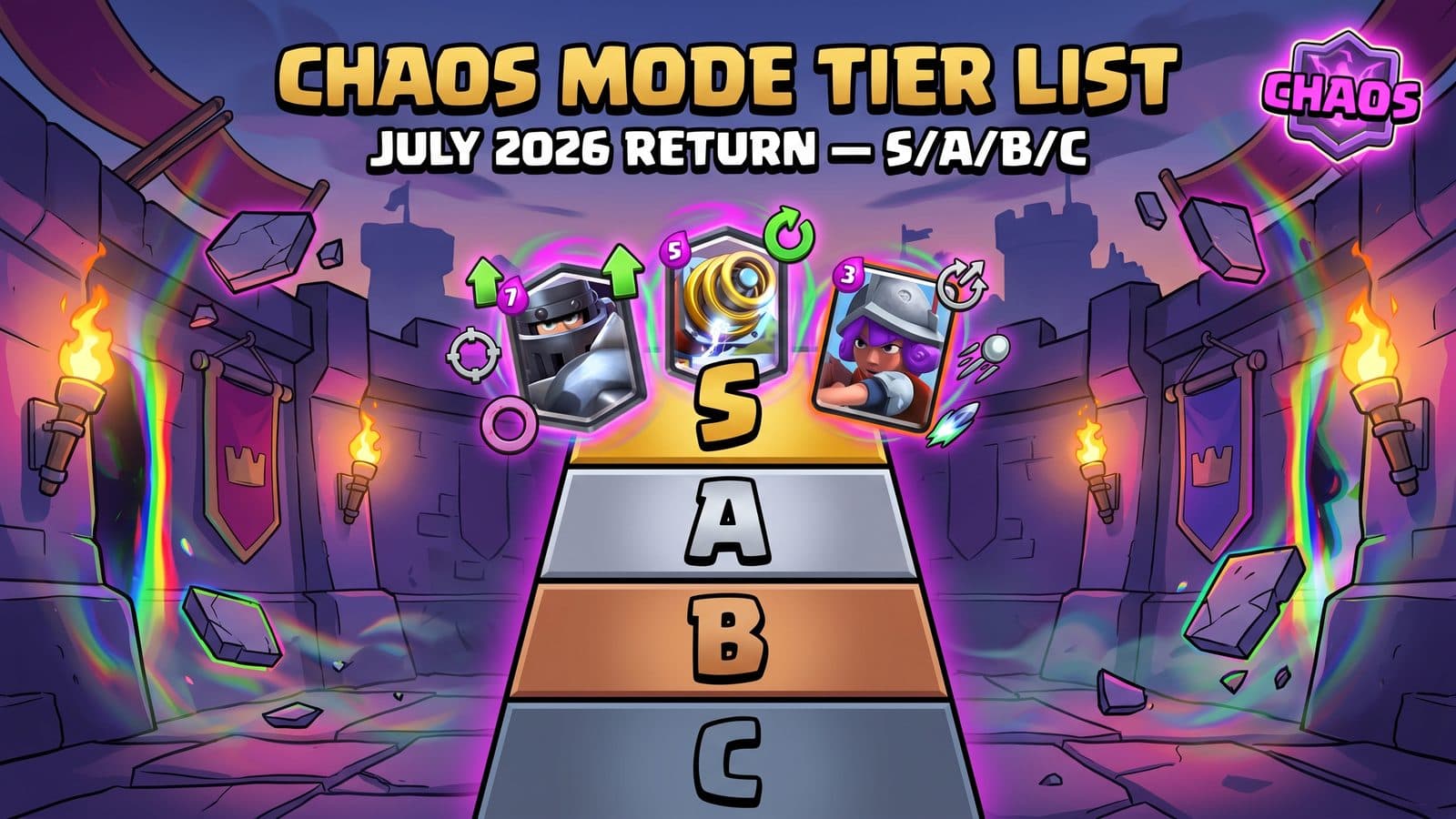
Quick answer: The best CHAOS Mode decks are built around cards whose Epic modifier changes what the card is, not how fast it does its job — Mega Knight (unlimited jump attacks), Knight (spawns a Mega Knight), Goblin Giant (Sparky Spear Goblins) and Wizard (spawns a Wizard Trio) are the four highest-ceiling Epics in the 50-card pool. S-tier picks for the Season 86 return are Mega Knight Beatdown, Goblin Giant Witch Spawn, and Royal Giant Control. Cycle and bait shells drop to B-tier because their cheap cards convert modifier picks into small percentage buffs.
CHAOS Mode is the only Clash Royale format where a 3-elixir card can become more valuable than an 8-elixir card mid-match. The mode runs a 50-card pool with 150 modifiers — three per card, one Common, one Rare, one Epic — and hands you up to 5 of them across a single match, so the decks that consistently win share three properties: cards whose Epic modifier replaces their function rather than buffing it, redundant win conditions so a bad roll doesn't end the match, and spells that stay useful at modifier zero. Ten cards are banned from the mode outright — Barbarian Hut, X-Bow, Golem, Electro Wizard, Goblin Demolisher, Goblin Barrel, Vines, Dart Goblin, Suspicious Bush and Poison, removed on March 31, 2026 — so any list built on them cannot be drawn. CHAOS returned on August 3, 2026 with Season 86 "K.H.A.O.S" and runs through September 7, in six variants including Triple Draft, Epic Only, Sudden Death and Infinite Elixir.
Rate your deck against this meta
Get an instant AI grade, synergy score, and swap picks — build a deck below, or sign in to grade your current one. Free to start.
What Makes a Deck Good in CHAOS Mode?
Three properties separate S-tier CHAOS decks from C-tier:
1. Epic modifiers that replace the card, not buff it. The published Epic modifiers split cleanly into two groups. One group changes what the card is: Knight's "Not This Guy Again!" spawns a Mega Knight, Wizard's "Zap! Ouch! Brrr!" spawns a Wizard Trio, Goblin Giant's "Elec-trick-tians" turns his Spear Goblins into Sparky-projectile shooters, Mega Knight's "Ultra Mega Power Jump" makes him jump-attack continuously, Musketeer's "#Girlbosses" turns her into 2 Elite Musketeers, The Log's "Chop! Chop!" spawns a Lumberjack. The other group scales a number: Hunter's +100% shot range, Flying Machine's +100% hit speed, Executioner's +100% hitpoints. Decks built on the first group win matches the second group cannot.
2. Redundant win conditions. A single-win-con CHAOS deck dies when its main card draws the number-scaling modifier instead of the replacement one. Decks with two potential threats (Mega Knight + Knight, Goblin Giant + Witch) survive bad rolls because at least one of them can still be handed a match-changing Epic across the picks.
3. AoE spells over single-target spells. Random modifiers hit AoE spells less brutally. Fireball is a Fireball at modifier zero and a mirrored double-Fireball at its Rare — it kills swarms and damages towers either way. Note that Poison is banned from the mode, so the standard heavy-spell package is Fireball, Rocket, Earthquake and The Log.
The fourth, subtler property: small-card-heavy decks underperform because their modifier draws are less impactful per pick. A deck of heavy cards gives every modifier pick high upside. A cheap cycle deck has the same number of picks but a lower ceiling per pick, even if the deck plays better on ladder.
Playing one of these decks?
Deck Doctor grades any deck in seconds — synergy, meta fit, and the swaps that fix its weak spots. See your grade before you sign up.
The CHAOS Mode Tier List (S/A/B/C)
Tier here is an editorial judgment, not a measured win rate: it weighs published Epic-modifier ceiling, how many cards in the shell carry a function-replacing Epic, redundancy across win conditions, and whether every card is legal in the mode.
| Tier | Archetype | Why It's Ranked Here |
|---|---|---|
| S | Mega Knight Beatdown | Mega Knight, Knight and Wizard Epics in one shell |
| S | Goblin Giant Witch Spawn | Three spawn-replacement Epics + dual threats |
| S | Royal Giant Control | Royal Hog projectile Epic + Inferno Tower triple-target |
| A | Lava Hound Air | Continuous Lava Pups + Evo Bats, few air answers in pool |
| A | Giant Wizard | Charging Giant Rare + Wizard Trio Epic |
| A | Graveyard Ice Wizard Control | Freeze attacks Epic + random-skeleton Graveyard |
| B | Mortar Cycle | Barbarian-launcher Rare is real, but one-trick |
| B | Hunter Flying Machine Cycle | Almost all number-scaling modifiers |
| C | Fisherman Chip | Strong Rare, no match-ending Epic |
| C | Skeleton-swarm cycle (gimmick) | Almost no ceiling on any card |
S-Tier CHAOS Decks: 3 Builds That Dominate
S-Tier Build 1: Mega Knight Beatdown
Cards: Mega Knight, Wizard, Musketeer, Baby Dragon, Knight, Tombstone, Fireball, The Log. Average elixir: 4.0.
Mega Knight Beatdown is S-tier because it stacks four function-replacing Epics in one shell. Mega Knight's Epic, "Ultra Mega Power Jump", makes him jump-attack continuously instead of once on landing. Knight's Epic, "Not This Guy Again!", spawns a Mega Knight — the cheapest 3-elixir card in the deck can become a second tank. Wizard's Epic spawns a Wizard Trio, and Musketeer's turns her into 2 Elite Musketeers. Whichever of the four you are offered, the pick changes the board. See the Mega Knight Guide for his base kit.
The base game plan before any modifiers land: defend cheaply with Knight, Wizard and Tombstone, and do not overcommit. Crown Towers have double health in CHAOS, so chip plans are slow and the match is decided by which side converts a replacement Epic into a push first. If the pick enhances Mega Knight, start him at the back and stack Wizard behind. If it enhances Knight, you now have a two-tank push for 10 elixir. If it enhances Wizard or Musketeer, play defence-first and counterpush into a lane the opponent has already spent on.
S-Tier Build 2: Goblin Giant Witch Spawn
Cards: Goblin Giant, Witch, Night Witch, Baby Dragon, Knight, Tombstone, Fireball, The Log. Average elixir: 3.9.
Goblin Giant Witch Spawn earns S-tier on modifier density: five of its eight cards carry a spawn-replacement modifier. Goblin Giant's Epic, "Elec-trick-tians", makes the Spear Goblins on his back fire Sparky projectiles instead of spears. Witch's Epic, "Skelebrate Good Times", spawns Evolved Skeletons instead of normal ones, and her Common alone doubles spawn speed. Night Witch's observed modifier, "Purple Please!", spawns Evolved Bats. Tombstone's Epic, "Tomb of the King", swaps its Skeletons for Guards and drops a Skeleton King on death. Knight's Epic spawns a Mega Knight.
The deck also benefits from redundancy. If the opponent draws a hard answer to Goblin Giant, you pivot to a Witch and Night Witch spawn push in the opposite lane and let the accumulated troops do the work. Tombstone and Baby Dragon cover the defensive floor while the spawn modifiers stack.
S-Tier Build 3: Royal Giant Control
Cards: Royal Giant, Musketeer, Wizard, Knight, Fisherman, Inferno Tower, Fireball, The Log. Average elixir: 4.0.
Royal Giant Control is the highest-floor of the three S-tier lists — it functions at modifier zero and gets better with every pick. Royal Giant's Rare, "Look Out, Over There!", triples his range (+200%); his Epic, "Let Loose the Hogs of War", makes every shot fire a Royal Hog. Inferno Tower's Rare, "I Triple Dog Dare You", gives it three simultaneous targets, and its Epic locks the beam at maximum damage from the first tick. Fisherman's Epic, "Hook Me Baby One More Time", gives the hook infinite range, which pulls a committed win condition out of a push from anywhere on the board.
The deck's weakness is the opening before any modifier lands, when Royal Giant is a 6-elixir card any Inferno answers. Survive that window with Knight, Musketeer and Inferno Tower, then commit once your first replacement Epic is on the board.
A-Tier CHAOS Decks: 3 Solid Picks
A-Tier Build 1: Lava Hound Air
Lava Hound Air is A-tier because air-targeting defence is thin in the CHAOS pool and its modifiers compound. Lava Hound's Epic, "Like Bunnies", periodically spawns 2 Lava Pups at the back while she is still in Hound form — a continuous stream rather than a one-time death split. Her Rare drops 6 Fire Spirits when she splits, and her Common quintuples her fire rate. Night Witch's Evo Bats modifier adds a second air swarm. The reason it is A-tier and not S-tier: at modifier zero the deck has lower base power than the Mega Knight or Goblin Giant builds, both of which function well before any pick lands.
Suggested cards: Lava Hound, Night Witch, Baby Dragon, Flying Machine, Hunter, Tombstone, Fireball, The Log. Average elixir: 4.0.
A-Tier Build 2: Giant Wizard
Giant plus Wizard is a two-payoff shell where both cards have published replacement modifiers. Giant's Rare, "Large & In Charge", turns him into a charging Giant; his Epic, "World's Largest Barrel", converts him into a Giant Barrel. Wizard's Epic spawns a Wizard Trio behind the push, and Executioner's Epic, "Axed with the Wind", puts a Tornado on his axe. The combination forces the opponent to answer a tank, a triple splash unit and a pull effect with the same defensive placement.
Suggested cards: Giant, Wizard, Musketeer, Knight, Executioner, Tombstone, Fireball, The Log. Average elixir: 3.9.
A-Tier Build 3: Graveyard Ice Wizard Control
Graveyard's Epic, "They're Skeverywhere!", spawns random Skeleton troops instead of plain Skeletons, and its Rare spawns Guards. Ice Wizard's Epic, "Simon Says: Freeze!", makes his attacks freeze outright rather than slow — the single strongest defensive modifier in the pool — and his Rare makes the slowdown permanent. The deck plays for a long game and wins when a freeze modifier turns every defensive stand into a free counterpush.
Suggested cards: Graveyard, Ice Wizard, Knight, Musketeer, Inferno Tower, Baby Dragon, Fireball, The Log. Average elixir: 3.8.
B-Tier and Why They Underperform in CHAOS Mode
Mortar Cycle drops to B-tier. Mortar's Rare, "Be the Boulder", converts it into a Barbarian launcher, which is a genuine match-changer — but the shell around it is cheap cycle cards whose modifiers scale numbers. Single-win-condition decks are punished hardest by CHAOS's randomness: if the Mortar pick does not come, there is no Plan B.
Hunter Flying Machine Cycle has the same issue and less upside. Hunter's Common is +100% shot range and Flying Machine's is +100% hit speed — both were captured directly from the in-match prompt, and both are exactly the kind of percentage buff that leaves you behind a Wizard Trio. Hunter's Epic (a flamethrower attack) and Rare (invisible when not attacking) are real, but one good Epic across eight cards is not a plan.
Cheap cycle shells generally are the decks people pick when they want a "safe" option, and it is usually the wrong call in this mode. Variance is what wins CHAOS; picking against variance is picking against the mode's central mechanic.
Which Modifiers Matter Most?
Supercell has not published a category breakdown or per-category counts for the 150 modifiers, so treat any list of "how many modifiers are damage modifiers" as invented. What is published is the individual card entries, and reading across them the useful split is functional:
Replacement modifiers. The card stops being itself. Knight spawns a Mega Knight. Wizard spawns a Wizard Trio. Tombstone spawns Guards and a Skeleton King. Witch spawns Evolved Skeletons. Musketeer becomes 2 Elite Musketeers. Baby Dragon's egg spawns an Evo Dragon. Mortar becomes a Barbarian launcher. These decide matches.
Behaviour modifiers. The card keeps its identity but gains a new rule: Inferno Tower hits three targets, Fisherman's hook has infinite range, Ice Wizard freezes, Fireball leaves the ground burning, Mega Knight jumps continuously. Nearly as strong, and usually easier to play around.
Scaling modifiers. +100% range, +200% hit speed, +100% hitpoints. Real value, rarely decisive. If most of your deck's published modifiers are in this group, change decks.
For card-by-card modifier lookups, see the CHAOS Modifier Database and the parent CHAOS Mode Guide.
Playing one of these decks?
Deck Doctor grades any deck in seconds — synergy, meta fit, and the swaps that fix its weak spots. See your grade before you sign up.
How to Read the Match-Start Modifier Reveal
The battle pauses while both players choose, and it resumes only once both have locked in or timed out — so the prompt is a short, high-pressure decision, not a planning phase. The way to win it is to know your priority order before you queue, not to reason it out in the moment.
Rule 1: a win-condition modifier beats a support modifier. If one option enhances Mega Knight, Goblin Giant or Royal Giant and the other enhances Wizard or Knight, take the win condition even if the specific modifier is the weaker of the two — it is the card the whole deck is built to protect.
Rule 2: a replacement Epic beats any percentage. "Spawn Mega Knight" on a 3-elixir Knight is worth more than +200% anything.
Rule 3: read the lane implication immediately. A defensive splash upgrade tilts you toward letting the opponent commit first. A win-condition upgrade tilts you toward immediate offence.
Rule 4: never time out. If the timer expires the game picks for you, and it often picks the worse option.
Reading the opponent's picks matters just as much. Prompts come roughly every 45 seconds through the first three picks and about 60 seconds before the fourth, with a fifth in overtime — so by the third pick both sides have cards behaving in ways their base kit does not explain. If their Ice Wizard freezes your push outright, they took his Epic and you must stop clumping defenders. If their Fireball pulls a Tornado before impact, you cannot stack troops near towers any more.
How the Season 86 Return Changed This Tier List
C.H.A.O.S returned on August 3, 2026 with Season 86 "K.H.A.O.S" and runs to September 7 in six variants: base C.H.A.O.S, Triple Draft (from August 17), Epic Only, Sudden Death, Ken's C.H.A.O.S Mega Draft and Infinite Elixir (from August 31). The largest structural change since the first run is the ban list applied on March 31, 2026, which removed Barbarian Hut, X-Bow, Golem, Electro Wizard, Goblin Demolisher, Goblin Barrel, Vines, Dart Goblin, Suspicious Bush and Poison. Every deck in this tier list is checked against that list.
What has not changed: the structural principles. Cards with function-replacing Epics, decks with redundant win conditions, AoE spells over single-target — these remain the deck-building criteria regardless of which cards sit in the pool.
For broader context on evolution cards, see Evolution Cards Guide. For deeper deck-building theory that applies across modes, see Deck Building Guide. For the badge meta, see CHAOS Mode Badges Guide.
Frequently Asked Questions
What's the best deck for CHAOS Mode in 2026?
The best deck for CHAOS Mode in 2026 is Mega Knight Beatdown — Mega Knight, Wizard, Musketeer, Baby Dragon, Knight, Tombstone, Fireball, The Log. Four of its eight cards carry an Epic modifier that replaces the card's function rather than buffing a number, so most picks you are offered change the board. Average elixir is 4.0, heavier than ladder norms but correct for a mode that rewards high-ceiling cards.
Which cards are banned from CHAOS Mode?
Ten cards have been banned from C.H.A.O.S since March 31, 2026: Barbarian Hut, X-Bow, Golem, Electro Wizard, Goblin Demolisher, Goblin Barrel, Vines, Dart Goblin, Suspicious Bush and Poison. Any CHAOS deck list containing one of them cannot be drawn in the mode.
Is Hog Cycle good in CHAOS Mode?
Hog Cycle is B-tier in CHAOS Mode, not S-tier. The shell wins on raw cycle speed, but its cheap cards convert modifier picks into small percentage buffs rather than function changes. Compared with a deck where 4 of 8 cards can be handed a replacement Epic, Hog Cycle's picks feel marginal. It is playable, but it is not the deck for a 3-win streak attempt.
How do modifiers work in CHAOS Mode?
CHAOS Mode gives each player up to 5 modifiers per match, chosen from 2 options at a time, with the battle paused during the choice. Prompts arrive roughly every 45 seconds through the first three, about 60 seconds before the fourth, and a fifth in overtime. Rarity escalates by probability rather than a fixed ladder: pick 1 is 90% Common / 10% Rare, pick 2 is 20% Common / 80% Rare, pick 3 is 50% Rare / 50% Epic, pick 4 is 20% Rare / 80% Epic, and the overtime pick is 100% Epic. Every card has exactly 3 modifiers and none repeats in a match.
When does CHAOS Mode run in Clash Royale?
C.H.A.O.S returned on August 3, 2026 with Season 86 "K.H.A.O.S" and runs through September 7, 2026. Six variants run inside that window: base C.H.A.O.S, Triple Draft (August 17 onward), Epic Only, Sudden Death, Ken's C.H.A.O.S Mega Draft (August 24-29) and Infinite Elixir (August 31 onward).
What are the CHAOS Mode badges?
C.H.A.O.S has 3 Legendary badges, all titled "Secret C.H.A.O.S Badge". "Don't lose..." is won by taking three battles in a row. "Go for the King..." is won by winning a battle without damaging the Crown Towers, the King Tower excepted. "What can I say..." requires choosing 4 specific modifiers in one match: Goblin Hut's Rare, Mortar's Rare, Rocket's Rare and Wizard's Epic. See CHAOS Mode Badges Guide for the full breakdown.
Should I play CHAOS Mode for trophies or rewards?
Play CHAOS Mode for rewards, not trophies — CHAOS wins do not award ladder trophies, but they do count toward daily win requirements and the mode's own C.H.A.O.S Trophy track, which runs 0-14 in the Casual League and reaches the Competitive League at 15 for a Season Badge. If your goal is trophies, play Ranked Ladder.