

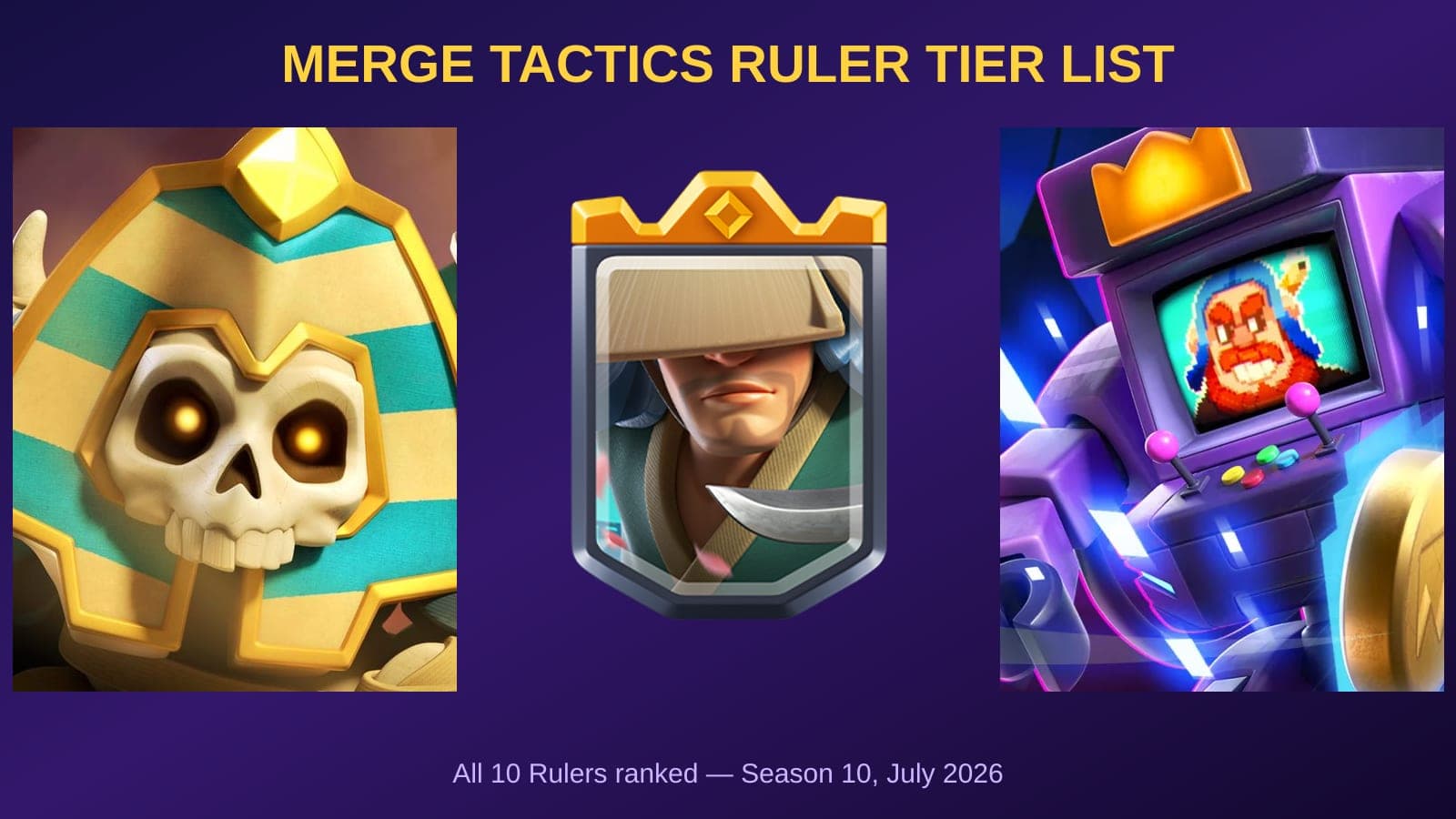
Quick answer: The best Ruler in Merge Tactics is Spirit Empress — her Fusion Foresight ability grants +1 bonus Elixir on every merge, compounding into the strongest economy in the mode — even after the August 4, 2026 patch raised her quest milestones to 3/20/60. Grand Warden (infinite-duration shields, 3-tile first-shield AOE since July 2) remains the S-tier co-pick. Ronin sits in B-tier as a swarm-punisher whose value depends on lobby composition.
Merge Tactics Season 10 (July 13 – September 1, 2026) brings the Ruler roster to 10 commanders, and the gap between the best and worst pick is larger than most players realize: an S-tier economy Ruler like Spirit Empress can generate 10+ bonus Elixir per game through normal play, while a C-tier pick like Battle Machine gives up a team slot from turn 5 onward. This tier list ranks all 10 Rulers on four weighted criteria — economy value, combat value, Ruler Quest ease, and flexibility — using the May 26, June 1, July 2, and August 4, 2026 balance data. The August 4 mid-season patch rebalanced quest objectives for 5 of the 10 Rulers, and Supercell's same post revealed a July 2 patch that had never been announced.
Rate your deck against this meta
Get an instant AI grade, synergy score, and swap picks — build a deck below, or sign in to grade your current one. Free to start.
What Is the Best Ruler in Merge Tactics?
Spirit Empress is the best Ruler in Merge Tactics as of August 2026 — Supercell's own August 4 patch notes call her "still dominating the top Arenas" — followed closely by Grand Warden. The full Season 10 ranking:
| Tier | Ruler | Ability | One-line verdict |
|---|---|---|---|
| S |  Spirit Empress Spirit Empress | Fusion Foresight (+1 Elixir per merge) | Compounding economy tied to the mode's core loop; quest raised to 3/20/60 on Aug 4 |
| S | Grand Warden | Shield Sponsor (random shields at 5s/15s) | Infinite shields + 3-tile first-shield AOE since Jul 2; quest raised to 3/10/20 |
| A | Elixir Loong | Endless Spring (+1 Elixir/round, +1 Team Size) | Flat economy plus a permanent board-size edge |
| A | Royale King | Royal Commission (+4-8 Elixir on round loss) | The loss-streak engine — quest raised to 2/3/4 on Aug 4 |
| A | Tomb Queen | Regal Revival (Tombstone → joins the fight) | Two-stage value; buffed Jul 2 (150% Tombstone HP), quest eased again Aug 4 (3/15/50) |
| B | Ronin | Double Edge (pre-battle tile trap, X-strike) | New in S10 — high ceiling vs swarm lobbies, unproven |
| B | Echo Sage | Reworked in Season 11: once per round the Echo charges, KOs the target and surrounding enemies, then vanishes for the round | Quest now 2/4/8 knockouts in one game; levels at 2/4/8 KOs — re-evaluate once Season 11 data lands |
| B |  Dagger Duchess Dagger Duchess | Dagger Donation (+1 Range, +180% Hit Speed for 8 attacks) | Carry-amplifier; buffed to 20% bonus damage May 26 |
| B | Goblin Queen | Greener Grin (33% Goblin on enemy defeat) | Quest eased to 2/8/20 on Aug 4; strong only in Goblin-trait builds |
| C | Battle Machine | Building Master (random buildings, −1 Team Size) | The Team Size penalty outweighs random building value |
Playing one of these decks?
Deck Doctor grades any deck in seconds — synergy, meta fit, and the swaps that fix its weak spots. See your grade before you sign up.
How Are the Rulers Ranked?
The ranking weighs four criteria, in descending order of impact on your average finish position:
- Economy value (40%): Merge Tactics rounds are won by whoever fields the strongest board, and boards are built with Elixir. Abilities that generate Elixir — per merge, per round, or per loss — compound across a 10+ round game.
- Combat value (30%): Direct battlefield impact — shields, summons, strikes, buffs — measured by how often it decides a close round.
- Ruler Quest ease (20%): Since Season 9, each Ruler's Quest feeds Quest Orbs worth up to 24 Elixir or a 3-star troop. A quest you complete passively is worth more than one that warps your play.
- Flexibility (10%): Does the Ruler demand a specific composition (Goblin Queen) or work with anything (Spirit Empress)?
Who Are the S-Tier Rulers?
Why Is Spirit Empress S-Tier?
Spirit Empress converts the game's core mechanic into free money. Fusion Foresight grants +1 bonus Elixir every time you merge troops — and merging is something you do 10-20 times per game regardless of strategy. That's 10-20 bonus Elixir with zero behavioral change, the equivalent of 2-4 free shop troops.
Her Ruler Quest (merge 3 / 20 / 60 troops in one game) still completes through normal play, though the August 4, 2026 patch raised milestones 2 and 3 by 33% and 20% (from 3/15/50) — Supercell's stated goal was to let "other Rulers catch up" to a Ruler "still dominating the top Arenas." The nerf targets her quest economy, not Fusion Foresight itself, so her core compounding advantage is untouched and she stays the #1 pick.
Play her when: always viable. Skip her when: you've already mastered her and want quest variety.
Why Is Grand Warden S-Tier?
Grand Warden's shields no longer expire. The May 26, 2026 balance pass changed his Shield Sponsor effect duration from 8 seconds to infinite (Star Shield excepted) — he grants a random shield to the lowest-HP% ally at the 5-second and 15-second marks of every combat, and since the buff those shields persist until broken. The second shield also detonates in a 3-tile radius when it breaks. The July 2, 2026 patch widened his first shield's AOE from 1 tile to 3 tiles (+200%) after Supercell judged the mechanic "hard for players to adapt to."
In long rounds — exactly the rounds that decide top-2 finishes — a free permanent shield on your weakest unit is routinely the difference between holding and folding a flank. His quest (shields affect 3 / 10 / 20 troops in one game) still progresses passively — the August 4 patch raised the first two milestones from 2/8/20 because the July AOE buff "made it too easy to complete his quests."
Play him when: you run sustain comps that extend rounds. Skip him when: the lobby modifier forces fast rounds (e.g., time-pressure tiles).
Who Are the A-Tier Rulers?
Why Is Elixir Loong A-Tier?
Elixir Loong pays you twice: +1 Elixir every round and +1 maximum Team Size. The extra team slot is the quietly dominant half — fielding one more troop than your opponent every single round is a permanent material advantage that scales with game length. The flat Elixir drip is weaker than Spirit Empress's merge-scaling but requires literally nothing from you.
What keeps him out of S-tier is his Ruler Quest: win 2 / 3 / 5 rounds in a row. Streak quests are the most failable in the game — one bad matchup resets your progress — and chasing them can push you into over-committing Elixir early.
Why Is Royale King A-Tier?
Royale King is the loss-streak economy engine: +4-8 bonus Elixir every time you lose a round. The intended line is to sandbag early rounds, bank an enormous Elixir lead, and buy a late-game board nobody can answer. It's still strong — but it was stronger before the May 26 nerf cut his Hitpoints from 12 to 10, which shortened the leash on intentional losing (each loss also costs Ruler HP, and at 10 HP you can afford roughly one fewer sandbagged round).
His quest embraces the play pattern: lose 2 / 3 / 4 rounds in one game (raised from 1/2/4 on August 4, 2026 — Supercell judged the first two milestones "too easy"). You'll still complete it by accident in most games, but the first Orb no longer lands on your first dropped round.
Why Is Tomb Queen A-Tier?
Tomb Queen is the only Ruler with two combat phases. Regal Revival spawns a Tombstone at combat start that summons a Skeleton every few seconds and levels up after 4, 8, and 16 total spawns; when the Tombstone is destroyed each round, Tomb Queen herself rises from it and joins the fight. She contributes board presence all game — passive Skeletons early, a direct combatant late — and counts toward the Undead trait.
Two 2026 patches have steadily strengthened her. The July 2 patch (announced August 5) gave her 150% of the Tombstone's HP on revival (up from 100%) and slowed her hit speed 0.5s → 0.6s — Supercell's fix for a Ruler who "often died before starting to fight." Then the August 4 patch eased her quest again: Tombstone summons 3/20/60 → 3/15/50 (after June 1 had already cut it from 10/25/80), because her success "depended too much on getting a Witch in the first two rounds." She rewards long-round comps the same way Grand Warden does, and the two pair with the same lineups. See the Season 9 hub for her full mechanical breakdown.
Who Are the B-Tier Rulers?
Where Does Ronin Rank at Season 10 Launch?
Ronin debuts in B-tier — a provisional placement until live data lands. His Double Edge ability is the first pre-battle decision in the mode: you pick a tile before combat, and the first enemy to step on it triggers an X-shaped strike with double damage on the center tile. Against swarm lobbies (Goblin and Undead stacks) the trap routinely connects with 3-5 units, and his quest — defeat 1 / 3 / 5 troops with Double Edge in one game — pays out for exactly that scenario.
The concern is variance: against dash-heavy or spread boards the trap catches one unit or nothing, contributing zero combat value that round. Rulers whose floor is "nothing happened" historically rank below the passive-value S/A group. If the Season 10 meta skews swarm-heavy (and the Electric trait's stun-synergy suggests clustered boards will be common), Ronin has a realistic path to A-tier — we'll re-rank after the first two weeks of live games. His unlock path is Starsteel-Road-only this season.
Why Is Echo Sage B-Tier?
Echo Sage summons The Echo — a clone that charges up and knocks out the nearest enemy (or enemies) when fully charged. Guaranteed KOs are real combat value, but the June 1 era nerf trimming her HP Growth per Star Level from 1.4 to 1.2 (−14.2%) removed the unkillable-wall dimension that made her oppressive in Season 9's opening weeks. Her quest was slashed in the July 2, 2026 patch from 2/6/18 to 1 / 3 / 7 knockouts in one game — Supercell acknowledged it was "harder to achieve than most Rulers" — making her one of the fastest Orb earners in the mode and the quietly biggest winner of the mid-season changes.
Season 11 rework (September 1, 2026): Echo Sage was rebuilt. Once per round she charges, knocks out the target AND surrounding enemies, then vanishes for the remainder of the round; she levels up after knocking out 2/4/8 enemies, and her Ruler Quest is now 2/4/8 knockouts in one game (up from the 1/3/7 of July 2). The multi-target KO is a bigger payoff, the vanish is a real cost, and the quest is harder — hold her at B until Season 11 lobbies show which way that trade nets out.
Why Is Dagger Duchess B-Tier?
Dagger Duchess donates one dagger per game to a troop of your choice: +1 Range and +180% Hit Speed for that troop's next 8 attacks, and since May 26 the daggers also carry a 20% bonus damage rider. On a hyper-carry (Musketeer, Archer Queen), the donation window can delete a frontline. But it's one buff, on one unit, once — against S-tier's compounding economies it's a single-round spike. Her quest (win rounds in under 8 seconds, 1 / 2 / 4 times) actively fights long-round strategies, which caps her pairing flexibility.
Why Is Goblin Queen B-Tier?
Goblin Queen joins the Goblin trait herself and rolls a 33% chance to gain a Goblin every time an enemy is defeated. In a committed Goblin build she's effectively a sixth trait member plus a free-unit engine — but outside Goblin comps, both halves of her kit do nothing. The May 26 HP buff (10 → 12) gave her more room to survive the fragile early rounds while the Goblin engine ramps — though Supercell's August 4 notes now call her "overrated with her extra 2 HP." That same patch eased her quest from 3/10/25 to 2 / 8 / 20 Goblins to make her "a more competitive choice amongst the other Rulers." It still only progresses in the same comps she demands. Highest ceiling in the tier, narrowest path to it.
Who Is C-Tier — and Why Is Battle Machine There?
Battle Machine trades a permanent team slot for random buildings. Building Master summons one random 1/2/3/4-star building in rounds 1, 3, 5, and 8 respectively — but at the cost of −1 maximum Team Size from turn 5 onwards. The first four rounds are played at full strength, which softens the cost in the early game and concentrates it exactly when boards get wide. That's the inverse of Elixir Loong's core strength, and the buildings arrive on a fixed schedule with random identity, so you can't build around them reliably. Buildings also can't reposition after round 1, making the random placement sticky.
His quest (buildings destroy 1 / 5 / 15 troops in one game) was eased on June 1 from 2/8/20, and dedicated building-synergy boards can make him work — but "can work with effort" against a structural material deficit is the definition of C-tier. If you're buying the Arcade Machine skin this season (which unlocks Battle Machine for free if you don't own him), treat him as a collection piece first.
Playing one of these decks?
Deck Doctor grades any deck in seconds — synergy, meta fit, and the swaps that fix its weak spots. See your grade before you sign up.
Which Ruler Should Beginners Pick?
Beginners should pick Spirit Empress, full stop. Her value requires zero game knowledge — merge troops (which the game constantly prompts you to do) and collect bonus Elixir. Royale King is the runner-up teaching tool: his loss-streak economy forces you to learn Merge Tactics' most counterintuitive lesson, that early-round losses are often correct plays.
Avoid Goblin Queen and Battle Machine until you're comfortable with trait breakpoints and building placement — both demand composition commitments a new player can't yet evaluate.
How Does Ronin Change the Ruler Meta in Season 10?
Ronin adds a rock-paper-scissors layer the Ruler roster didn't have. Every previous Ruler's value is lobby-independent — Spirit Empress's economy doesn't care what opponents field. Double Edge is the first ability whose value swings 3-5× based on enemy composition. Expect two second-order effects in Season 10: swarm players spreading formations to dodge predictable trap tiles, and Ronin players using the pre-battle tile pick as a mind game around common pathing lanes. The Electric trait's return cuts both ways — stun-clustered boards are great Double Edge targets, but Electric comps are Orb-gated and rare in early rounds.
What Common Mistakes Should You Avoid When Picking a Ruler?
Mistake 1 — Chasing the quest instead of the win: Elixir Loong's 5-win-streak and Dagger Duchess's under-8-second milestones tempt players into overspending 4-6 Elixir early to force wins. The Quest 3 Orb pays at most 24 Elixir — burning more than that to reach it is negative value. Play the game state; let quests complete when they complete.
Mistake 2 — Picking Goblin Queen before committing to Goblins: Her ability and quest both do literally nothing outside Goblin-trait comps. Decide on the Goblin build first, then pick the Ruler — 33% of players' Goblin Queen games start with a non-Goblin shop and never recover the tempo.
Mistake 3 — Sandbagging too deep with Royale King: Post-nerf he has 10 Hitpoints, and each lost round costs Ruler HP. Losing 4 rounds completes his final quest milestone and banks 16-32 bonus Elixir — losing 6 puts you one bad round from elimination before the Elixir lead converts.
Mistake 4 — Placing Ronin's trap where enemies were, not where they'll be: Double Edge triggers on the tile you picked before combat, against a board your opponent just changed. Read the enemy's persistent formation habits (most players don't reposition between rounds) rather than reacting to the last round's exact layout.
Mistake 5 — Valuing combat abilities over economy in the early rounds: Grand Warden's shields and Echo Sage's Echo feel impactful because you can see them fight. Spirit Empress's +1 Elixir per merge is invisible — and worth roughly one extra troop every 3 rounds, which compounds into the stronger board by round 8. When in doubt, take the economy.
Frequently Asked Questions
Who is the best Ruler in Merge Tactics right now?
Spirit Empress is the best Ruler as of August 2026 — Supercell's August 4 patch notes describe her as "still dominating the top Arenas." Fusion Foresight grants +1 bonus Elixir on every merge — typically 10-20 bonus Elixir per game — and even with her quest raised to 3/20/60 it completes through normal play. Grand Warden is the S-tier alternative since his shields became infinite-duration on May 26, 2026.
Is Ronin good in Merge Tactics Season 10?
Ronin launches in B-tier. His Double Edge tile trap deals X-pattern damage with a double-damage center and can swing entire rounds against swarm comps, but contributes nothing when the trap misses. He has A-tier potential if the Season 10 meta clusters boards; we'll re-rank after two weeks of live play.
What is the worst Ruler in Merge Tactics?
Battle Machine is the weakest Ruler in July 2026. His Building Master ability costs −1 maximum Team Size from turn 5 onwards in exchange for four random buildings on a fixed schedule — a late-game material deficit that random value can't reliably repay.
How do I unlock more Rulers in Merge Tactics?
Rulers unlock through Starsteel Road progression and, in most seasons, Ruler Cosmetics Shop purchases. Season 10's Ronin is Starsteel Road only — no shop option — while buying the Arcade Machine skin (in the shop) unlocks Battle Machine for free if you don't own him.
Which Ruler has the easiest Ruler Quest?
Echo Sage's quest moved twice: cut to 1/3/7 knockouts on July 2, 2026, then raised to 2/4/8 in the September 1 Season 11 rework — still completable through normal play, no longer the free orb it was. Spirit Empress (merge 3/20/60) and Royale King (lose 2/3/4 rounds) still complete through normal play despite their August 4 increases. The hardest remain Elixir Loong's win-streak quest (2/3/5 consecutive wins) and Dagger Duchess's speed-win quest (win rounds in under 8 seconds).
Did any Rulers get nerfed or buffed recently?
Yes — the August 4, 2026 mid-season patch rebalanced quest objectives for 5 Rulers: Spirit Empress (3/15/50 → 3/20/60), Grand Warden (2/8/20 → 3/10/20), and Royale King (1/2/4 → 2/3/4) got harder quests, while Goblin Queen (3/10/25 → 2/8/20) and Tomb Queen (3/20/60 → 3/15/50) got easier ones. The same post revealed a previously unannounced July 2 patch: Echo Sage's quest slashed to 1/3/7, Grand Warden's first-shield AOE tripled to 3 tiles, and Tomb Queen buffed to inherit 150% of her Tombstone's HP. Full details in the mid-season balance breakdown. Season 11 (September 1, 2026) then reworked Echo Sage outright — multi-target KO charge, vanish for the round, quest 2/4/8 — and made four Ruler cards collectible on the extended Starsteel Road (Royale King, Elixir Loong, Battle Machine, Dagger Duchess), up from two; see the Season 11 hub.
Does Tomb Queen count toward the Undead trait?
Yes. Tomb Queen's Tombstone counts as an Undead trait member, contributing to your Undead bonus while it summons Skeletons (leveling up at 4, 8, and 16 spawns) — and when it's destroyed, Tomb Queen herself joins the fight.
Where to Go Next
- Everything new this season: Merge Tactics Season 10 Hub
- Last season's systems explained: Merge Tactics Season 9 Hub
- Chat with this guide inside an AI: TrophyCoach on ChatGPT or Google Gemini